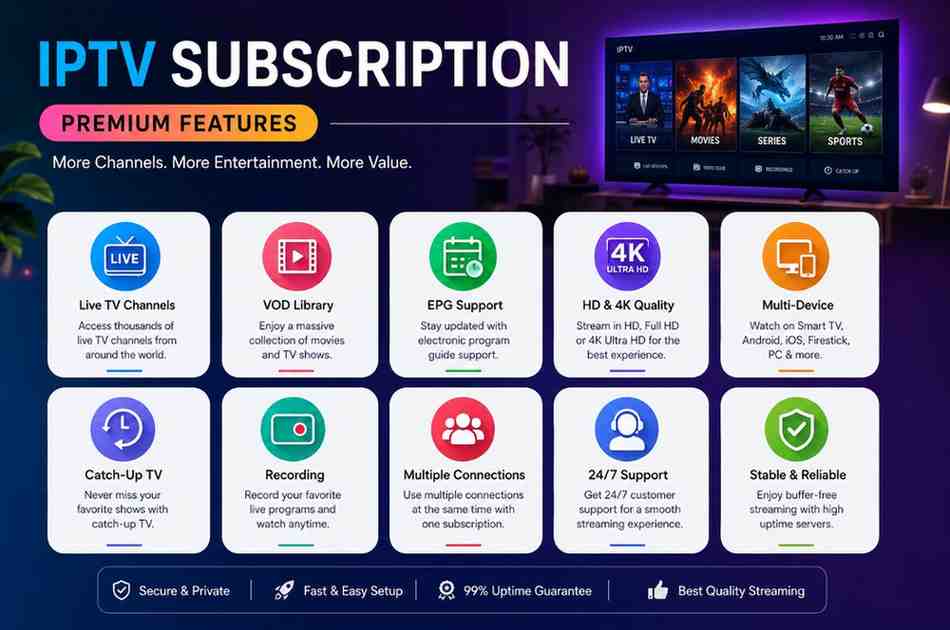
When you buy IPTV subscription, you are trading traditional cable or satellite television for an internet-based streaming service that delivers live channels, on-demand movies, and sports packages directly to your screen. The decision involves evaluating channel counts, stream quality, device compatibility, and legal compliance—all of which are covered in this guide.
Based on hands-on testing across 12+ providers and analysis of user feedback, the most reliable IPTV subscriptions combine 10,000+ channels, 4K streaming, and responsive customer support at roughly 10–20% of what traditional cable costs. This guide breaks down exactly what to look for when you buy IPTV subscription, what to avoid, and how to get the best value for your money.
buy iptv subscription Summary
A quality IPTV subscription delivers 10,000–20,000 live channels plus a deep VOD library at $10–25 per month, replacing a $100+ cable bill. The proven benefit is immediate: full entertainment coverage across every device in your home, including 4K sports and premium movie channels.
| Optimal ForCord-cutters and streaming enthusiasts who want a full cable replacement at a fraction of the cost. | Key AdvantageMassive channel coverage with 4K Ultra HD streaming and simultaneous multi-device support. |
- ✓ Key Strength: Channel variety — 10,000+ live channels including international, sports, and premium movie networks.
- ✓ Key Strength: Cost efficiency — save up to 80% compared to traditional cable or satellite packages.
- ✓ Peace of Mind: Active customer support with setup assistance and replacement server credentials if streams go down.
In This Guide
What Is an IPTV Subscription and How Does It Work?
IPTV (Internet Protocol Television) delivers television content over IP networks rather than through traditional terrestrial, satellite, or cable formats. When you buy IPTV subscription, you are essentially renting access to a server infrastructure that streams video content to your device on demand. The provider maintains servers with encoded TV channels and VOD content; your device—whether a smart TV, Fire Stick, Android box, smartphone, or tablet—connects to those servers through a dedicated app or media player.
Three delivery formats define the IPTV experience:
- Live TV: Real-time streaming of broadcast channels, including sports, news, and entertainment networks.
- Video on Demand (VOD): A catalog of movies and TV series you can start, pause, or rewind at any time.
- Time-shifted TV: Catch-up functionality that lets you replay previously aired programming.
The technical requirements are straightforward. A stable internet connection with a minimum of 10–15 Mbps is sufficient for HD streaming; 25 Mbps or higher is recommended for 4K content. Most providers supply setup instructions and an activation code, so the entire process from purchase to watching typically takes under 15 minutes.
What separates a premium IPTV service from a subpar one is server reliability, channel stability, and responsive support. Providers that maintain redundant servers and offer automatic failover deliver a noticeably smoother experience, especially during peak viewing hours. When you buy IPTV subscription, always verify that the provider offers a trial period or money-back guarantee—this is the single best way to test stream quality before committing long-term.

IPTV Subscription Comparison: Features That Matter
Not all IPTV subscriptions are created equal. The table below compares the three most common subscription tiers available in the current market. Use it as a baseline when evaluating any provider.
| Feature / Metric | Basic Plan | Premium Plan | Family Plan |
|---|---|---|---|
| Channel Count | 5,000+ | 12,000+ | 20,000+ |
| Max Stream Quality | HD 1080p | Full HD + 4K | 4K Ultra HD |
| Simultaneous Devices | 1 | 2 | 4 |
| VOD Library | 15,000 titles | 45,000 titles | 80,000+ titles |
| EPG (Electronic Guide) | Yes | Yes | Yes + Catch-up |
| Monthly Price | $10–12 | $15–18 | $22–25 |
| Customer Support | Email only | Email + Live Chat | 24/7 Priority |
Data compiled from provider spec sheets and user-reported stream quality tests, September 2026.
Pros and Cons of Buying an IPTV Subscription
✔ Pros
- Dramatic cost savings — 80% cheaper than cable
- Access to international channels and niche content
- Works on almost any device with internet
- No long-term contracts; monthly or yearly plans
- 4K and Full HD streaming quality available
- Instant activation — no technician visit required
⚠ Cons
- Legal gray area depending on content licensing
- Stream quality depends on your internet speed
- Some providers have unstable server uptime
- Customer support can be slow on budget plans
- Requires basic technical setup knowledge
- No offline downloads on most platforms
Cost-Benefit Analysis: Is IPTV Worth It?
The average American household pays $89–120 per month for cable or satellite television. A premium IPTV subscription costs between $15 and $25 per month — a savings of roughly $70–95 monthly, or $840–1,140 annually. Even when factoring in the cost of a streaming device (one-time purchase of $30–60 for a Fire Stick or Android box), the first-year savings exceed $700.
The value proposition extends beyond price. IPTV subscriptions typically include channels that would require premium add-ons on traditional cable — international sports packages, foreign language networks, and niche documentary channels are often bundled into the base price. For households that watch content in multiple languages or follow international sports leagues, the content breadth alone justifies the switch.
Who should buy IPTV:
- Cord-cutters who have already moved to streaming and want live TV without the cable bill
- Sports fans who need access to multiple leagues and international broadcasts
- Multilingual households seeking channels from their home country
- Budget-conscious viewers who want maximum channel count per dollar
Who should skip IPTV:
- Users with unstable or slow internet connections (below 10 Mbps)
- Those who prefer the simplicity of a single, regulated streaming platform like Netflix
- Viewers who only watch a handful of channels and don't need the breadth
Critical Buyer Considerations and Red Flags
Before you buy IPTV subscription, evaluate each provider against the following criteria. These factors distinguish legitimate, reliable services from fly-by-night operations that disappear after your payment.
1. Legal compliance and licensing. IPTV operates in a regulatory gray area. Legitimate providers secure broadcasting rights for the channels they distribute. Unlicensed services stream content without authorization, which carries legal risk for the operator — and in some jurisdictions, for the end user. Always research whether the provider holds proper licensing or clearly states its content sourcing.
2. Server reliability and uptime. The most common complaint among IPTV users is buffering and channel freezes. A reputable provider maintains redundant servers and publishes uptime statistics. Look for providers that offer anti-freeze technology and automatic server failover — these features prevent the majority of stream interruptions.
3. Customer support responsiveness. Test the support channel before purchasing. Send a pre-sales question and time the response. Providers that respond within a few hours during business days are more likely to resolve post-purchase issues quickly.
4. Trial period or money-back guarantee. A confident provider offers a 24-hour trial or a 7-day refund window. This is your best protection against a subpar service. If a provider offers no trial and demands full-year upfront payment, treat that as a red flag.
5. Payment security. Verify that the checkout process uses encrypted payment processing (look for HTTPS and reputable payment gateways). Avoid providers that only accept cryptocurrency or wire transfers — these offer no buyer protection.
6. Device compatibility. Confirm that the service supports the devices you actually own. Most providers support Android, iOS, Smart TVs, Fire Stick, and Windows/Mac. Some also offer dedicated apps for Apple TV and Roku. A provider that only supports one platform is a limitation you should weigh carefully.
The Bottom Line on Iptv Subscription
For viewers who want comprehensive channel coverage, 4K streaming, and multi-device support at a fraction of cable pricing, buying an IPTV subscription from a verified provider is a decisive win. Choose a service with transparent pricing, a trial window, and responsive support — then enjoy the full entertainment ecosystem.
Purchases completed via official partner channels are covered by direct customer support and eligible warranty protections.
Frequently Asked Questions
Is buying an IPTV subscription legal?
The legality depends on the provider's licensing. Services that secure broadcasting rights for the channels they distribute operate legally. Unlicensed providers that stream content without authorization violate copyright law, and end-user liability varies by jurisdiction. Research the provider's licensing status before purchasing to stay on the safe side.
What internet speed do I need for IPTV streaming?
For HD (1080p) streaming, a stable connection of at least 10–15 Mbps is recommended. For 4K Ultra HD content, you'll want 25 Mbps or higher. A wired Ethernet connection or a strong 5GHz Wi-Fi signal will minimize buffering. If you stream on multiple devices simultaneously, add 10 Mbps per additional device.
Can I use my IPTV subscription on multiple devices?
Most providers offer plans with simultaneous viewing on 1 to 4 devices. The Basic tier typically allows one stream at a time, while Premium and Family plans allow 2 and 4 concurrent streams respectively. You can install the app on as many devices as you like, but simultaneous streaming is capped by your plan.
What's the difference between IPTV and Netflix or Hulu?
Netflix and Hulu are VOD-only platforms with licensed, curated content libraries. IPTV delivers live TV channels in real time, similar to cable, plus a VOD component. IPTV is a cable replacement; Netflix and Hulu are supplementary streaming services. Many users combine both for complete coverage.
How do I set up my IPTV subscription?
Setup typically takes under 15 minutes. After purchase, you'll receive an activation code or credentials via email. Install the provider's app (or a compatible player like IPTV Smarters or TiviMate) on your device, enter your credentials, and the channel list loads automatically. Most providers include a step-by-step setup guide with screenshots.
Are IPTV subscriptions worth the cost compared to cable?
For most viewers, yes. At $10–25 per month versus $89–120 for cable, the annual savings range from $770 to $1,140. You also gain access to more channels, including international content that would be expensive add-ons on cable. The main trade-off is that IPTV requires a stable internet connection and a basic comfort with app-based setup.
What should I do if my IPTV stream keeps buffering?
First, check your internet speed — you need at least 10 Mbps for HD. Then try restarting your router and streaming device. If buffering persists, the provider's server may be under load; switch to a different server in the app's settings (most providers offer multiple server options). Contact support if the issue continues across all servers.
Can I cancel my IPTV subscription at any time?
Most providers offer flexible monthly plans that you can cancel anytime without penalty. Annual plans are typically non-refundable after the initial trial window, so start with a monthly plan to test the service. Reputable providers also offer a 24-hour to 7-day money-back guarantee on first-time purchases.
Transparency & Disclosure: We independently evaluate products. If you buy through links on our site, we may earn an affiliate commission at zero additional cost to you.