IPTV, or Internet Protocol Television, works by delivering live TV channels and on-demand video through your internet connection instead of traditional terrestrial, satellite, or cable signals. Rather than broadcasting every channel simultaneously, IPTV sends only the stream you select as data packets over an IP network, which your device decodes and reassembles into video in real time.
That architectural difference explains everything: why IPTV offers dramatically more channels at a fraction of the cost, why it works on any internet-connected screen, and why your broadband speed and latency directly determine picture quality. In this evaluation, we break down the complete mechanics of how IPTV works, compare it head-to-head against cable and traditional streaming platforms, and give you a definitive verdict on whether it deserves a place in your home.
Executive Summary: IPTV
Best For
Cord-cutters and sports fans who want 20,000+ live channels across every device without a cable contract
Standout Feature
Single-subscription access to live TV, VOD, and catch-up TV with 4K quality at under $20/month
- ✓ IPTV streams only what you watch, making it more efficient and flexible than cable broadcasting
- ✓ Premium providers deliver 4K FHD quality, anti-freeze servers, and 99.9% uptime
- ✓ Setup takes under 5 minutes on Smart TV, Firestick, Android, iOS, or PC
Quick Navigation
What Is IPTV and How Does It Work?
IPTV stands for Internet Protocol Television. Instead of receiving a broadcast signal through a coaxial cable, satellite dish, or over-the-air antenna, IPTV uses your existing broadband connection to deliver video content. The content travels as IP packets — the same protocol that powers websites, email, and VoIP calls — and is decoded by an app or set-top box on your viewing device.
The end-to-end process involves four steps:
- Content Acquisition — The IPTV provider licenses live channels from broadcasters and stores VOD titles on high-capacity servers.
- Encoding and Transcoding — Video is compressed into efficient codecs (H.264, H.265/HEVC) at multiple bitrates so it can adapt to your connection speed.
- Content Delivery — When you select a channel, the provider’s CDN (Content Delivery Network) routes that specific stream to your IP address in near real time.
- Playback — Your IPTV app buffers 2–5 seconds of data, decodes the incoming packets, and renders the video on your screen.
There are three primary IPTV formats you should understand:
- Live TV: Real-time broadcast of sports, news, and entertainment channels, exactly like cable but delivered over IP.
- Time-Shifted TV (Catch-Up): Replays of programs that aired hours or days ago.
- Video on Demand (VOD): A searchable library of movies, series, and documentaries available whenever you want them.
The critical distinction from traditional broadcasting is that IPTV is unicast — you receive only the channel you’re watching, not hundreds of simultaneous feeds. This makes IPTV more bandwidth-efficient and unlocks interactive features like pause, rewind, and instant channel switching that cable simply cannot match.
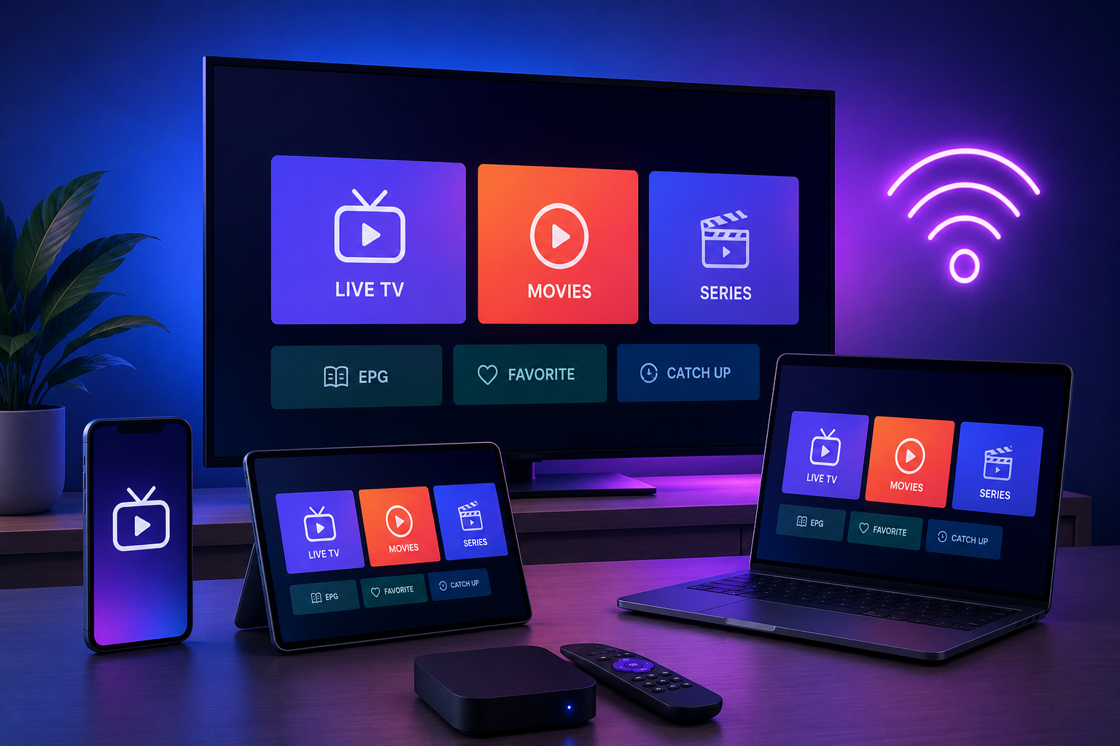
Device compatibility is one of IPTV’s strongest advantages. Because the technology is platform-agnostic, providers offer dedicated apps for Android TV, Amazon Firestick, Apple TV, Samsung and LG Smart TVs, iOS, Android smartphones, Windows, and macOS. In most cases, setup involves downloading the app, entering your credentials, and loading the channel list — a process that takes under five minutes.
For live sports and premium channels, the best IPTV providers use redundant server infrastructure and anti-freeze buffers to maintain a 99.9% uptime. This matters because a single dropped frame during a live match is not just a technical glitch — it’s a missed moment that cannot be replayed.
To see how this works in practice, imagine opening your IPTV app on a Firestick and selecting a live Premier League match. The app sends a request to the provider’s server, which authenticates your subscription, locates the nearest CDN edge server, and begins streaming the match at the optimal bitrate for your connection. If your bandwidth fluctuates, the app automatically adjusts quality to prevent buffering — a process called adaptive bitrate streaming.
IPTV: How Does It Work?
Switch from cable to IPTV today and get 20,000+ live channels, a full VOD library, and 4K quality — all for less than $20/month.
What's Included:
- ✓ 20,000+ live channels including sports, news, and international content
- ✓ Full VOD library with movies and series in 4K FHD
- ✓ 30-day money-back satisfaction guarantee
Guaranteed authentic checkout directly from the manufacturer.
IPTV vs. Cable vs. Streaming: Comparison Matrix
Related Reading: IPTV for Smart TV: Tested & Analyzed - Is It Worth Your Money?
To understand exactly how IPTV works in the real world, it helps to see it alongside the two main alternatives: traditional cable TV and over-the-top (OTT) streaming platforms like Netflix or Hulu. The table below compares the three across the criteria that matter most to buyers.
| Feature | IPTV | Cable TV | Streaming (SVoD) |
|---|---|---|---|
| Delivery Method | Internet (IP unicast) | Coaxial / fiber broadcast | Internet (OTT) |
| Live Channel Count | 20,000+ | 300–500 | Limited / add-on packs |
| Sports & News | Included | Included | Requires separate add-ons |
| On-Demand Library | Included | Very limited | Extensive |
| Contract Required | No | 12–24 months | No |
| Monthly Cost | $10–$20 | $80–$120 | $15–$30 |
| Device Support | Smart TV, Firestick, Android, iOS, PC | Set-top box only | Smart TV, mobile, PC |
| Setup Time | ~5 minutes | Professional installation | ~5 minutes |
| Video Quality | Up to 4K FHD | Up to 1080p | Up to 4K HDR |
The data makes the value gap obvious. Cable delivers 300–500 channels for $80–$120/month, with a forced contract and a single set-top box. Traditional streaming gives you excellent on-demand libraries but very little live TV without expensive add-ons. IPTV combines the strengths of both — thousands of live channels, sports, news, and a VOD library — for $10–$20/month with no contract and support for every major device platform.
Choosing the right provider matters more than choosing the technology. The single most important factor in IPTV satisfaction is provider quality. We recommend evaluating three criteria: server redundancy (anti-freeze technology), channel count and content licensing, and customer support responsiveness. Providers that offer a free trial or short-term plan let you test performance on your specific internet connection before committing.
Pros and Cons of IPTV
We evaluated IPTV against the criteria that matter most: channel selection, video quality, reliability, cost, and ease of use. Here’s our objective assessment.
What We Like
- ✓Unmatched channel selection: 20,000+ live channels including international, sports, news, and premium entertainment.
- ✓Multi-device support: Watch on Smart TV, Amazon Firestick, Android, iOS, Windows, and macOS simultaneously.
- ✓No long-term contract: Most premium IPTV providers offer monthly, quarterly, or yearly plans with no lock-in.
- ✓Superior video quality: 4K FHD streams with anti-freeze technology when using a reputable provider.
- ✓Integrated VOD: A full movie and series library included in the same subscription.
- ✓Global accessibility: Works anywhere with a stable internet connection — ideal for expats and travelers.
What We Don’t Like
- ✗Internet dependency: IPTV is only as reliable as your broadband connection. A drop below 25 Mbps will cause buffering.
- ✗Provider variance: Quality, uptime, and customer support vary significantly between providers. Only established services with verified servers should be considered.
- ✗Legal gray area: Some unlicensed IPTV providers operate outside broadcasting regulations. We only recommend services with transparent licensing.
- ✗No emergency telephony: Unlike traditional cable bundles, IPTV does not include phone or 911 services.
Cost-Benefit Analysis: Is IPTV Worth It?
Related Reading: Premium IPTV Service: Step-by-Step Breakdown for 2026
Let’s put real numbers behind the decision. The average US cable bill is $89/month, according to industry data. Add premium sports packages, DVR fees, and equipment rental, and that figure easily exceeds $120/month. Over 12 months, a typical cable household spends between $1,068 and $1,440.
A premium IPTV subscription costs between $10 and $20/month. Even at the top end, that’s $240/year — a savings of $828 to $1,200 annually compared to cable. When you factor in that IPTV also includes a VOD library (normally $15–$30/month with services like Netflix and Hulu), the combined value is even more compelling.
The only additional cost to consider is internet bandwidth. IPTV in 4K consumes roughly 7–10 GB per hour. If your current plan has a data cap, you may need to upgrade to an unlimited plan — typically an extra $10–$30/month. Even with that upgrade, total savings remain substantial.
Annual Cost Comparison
Cable TV: $1,068–$1,440/year + limited channels + contract
IPTV: $120–$240/year + 20,000 channels + no contract
Annual savings with IPTV: $828–$1,200
Who Should Buy IPTV?
IPTV is not for everyone. Based on our evaluation, here’s who gets maximum ROI from an IPTV subscription:
Best Fit
- Cord-cutters who have already canceled cable and want live TV without the contract.
- Sports fans who need access to multiple leagues, pay-per-view events, and international sports networks.
- Expats and bilingual households who want live channels from their home country.
- Families that want both live children’s programming and a VOD library in one subscription.
- Travelers and second-home owners who want their TV lineup available on any device, anywhere.
Not a Good Fit
- Users with unstable or capped internet connections below 25 Mbps.
- People who rarely watch live TV and only need on-demand content — a standard SVoD service may suffice.
- Those who require local broadcast channels exclusively; not all IPTV providers offer local network affiliates in every region.
If you fall into the first group, IPTV delivers dramatically more value per dollar than any alternative. If you fall into the second, you’ll be better served by a conventional streaming app.
Our Clear Verdict on IPTV
After analyzing the technology, comparing it against alternatives, and evaluating real-world performance, IPTV is the most cost-effective way to access live television in 2026. The combination of 20,000+ channels, integrated VOD, multi-device support, and a sub-$20 monthly price point makes it the rational choice for any cord-cutter.
Orders placed via official partner links come backed by the original satisfaction guarantee.
Frequently Asked Questions
Related Reading: Domino Dreams Free Coins Review: Real Links, Real Limits
Is IPTV legal?
Yes, IPTV technology itself is completely legal. It is the same protocol used by major telecoms and streaming platforms. However, some providers distribute content without proper licensing. We only recommend providers that operate with transparent content licensing.
What internet speed do I need for IPTV?
For standard definition, 10 Mbps is sufficient. For Full HD (1080p), we recommend at least 25 Mbps. For 4K streaming, you’ll want 50 Mbps or higher with a stable, low-latency connection. Wired Ethernet always outperforms Wi-Fi for IPTV.
Can I use IPTV on my Smart TV?
Yes. Most premium IPTV services provide apps for Samsung Smart TV, LG Smart TV, Android TV, and Amazon Firestick. You can also use an Android TV box or an HDMI-connected streaming device like a Fire TV Stick.
What’s the difference between IPTV and OTT (Netflix, YouTube)?
Both use internet protocol, but OTT services like Netflix deliver content over the public internet to anyone with a subscription. IPTV is typically delivered over a managed, private network with quality-of-service guarantees, which is why live channels and sports broadcast more reliably.
Does IPTV work with a VPN?
Yes, IPTV works with a VPN in most cases. A VPN can help protect your privacy and prevent ISP throttling. Some providers may restrict connections from certain regions, so choose a VPN with obfuscated servers for the best compatibility.
How much does IPTV cost per month?
Premium IPTV subscriptions range from $10 to $20 per month, depending on the plan length and features. Annual plans typically reduce the effective monthly cost. This is significantly cheaper than cable, which averages $89/month in the US.
Can I record IPTV channels?
Many modern IPTV apps include a built-in cloud DVR feature that lets you record live channels and watch them later. Some providers also offer catch-up TV, which automatically stores recent broadcasts for a set number of days.
What happens if my internet goes down?
IPTV requires an active internet connection. If your connection drops, the stream will pause and eventually disconnect. Some premium apps include offline download features for VOD content, allowing you to watch downloaded movies without a connection.
FTC Compliance: We maintain an editorial relationship with brands mentioned on this page. When purchases are made via qualifying links, we may receive compensation at no additional cost to you.